
By using this site, you agree to the Privacy Policy and Terms of Use.
Accept
ScienceabodeScienceabode
  • Home
  • News & Perspective
    News & PerspectiveShow More
    Microorganism that causes rare but severe eye infections detected in NSW coastal areas
    By Admin
    Scientists identify common cause of gastro in young children and adults over 50 years old
    By admin
    AI reveals hidden traits about our planet’s flora to help save species
    By admin
    Eye drops slow nearsightedness progression in kids, study finds
    By admin
    Using AI to create better, more potent medicines
    By admin
  • Latest News
    Latest NewsShow More
    Even thinking about marriage gets young people to straighten up
    By admin
    Study: People tend to locate the self in the brain or the heart – and it affects their judgments and decisions
    By admin
    UCLA patient is first to receive successful heart transplant after using experimental 50cc Total Artificial Heart
    By admin
    Via Dying Cells, UVA Finds Potential Way to Control Cholesterol Levels
    By admin
    Racial makeup of labor markets affects who gets job leads
    By admin
  • Health
    Health
    The World Health Organization defines health as “a state of complete physical, mental, and social well-being and not merely the absence of disease or infirmity.”…
    Show More
    Top News
    Tailored brain stimulation treatment results give new hope for people with depression
    June 16, 2025
    Game-Changer in Emergency Medicine: New AI Test Flags Sepsis Hours Before Symptoms Worsen
    June 4, 2025
    Perfumes and lotions disrupt how body protects itself from indoor air pollutants
    June 3, 2025
    Latest News
    AI set to make medical scan reports twice as easy to understand for patients
    March 16, 2026
    How Mtb safeguards itself from foreign DNA
    January 14, 2026
    Study: High-fat diets make liver cells more likely to become cancerous
    January 5, 2026
    Learning to play music can improve older people’s brain function, study suggests
    December 31, 2025
  • Environment
    EnvironmentShow More
    Coo-ee! Scientists tap into the inner workings of long-distance animal calls
    By Admin
    Some early life forms may have breathed oxygen well before it filled the atmosphere
    By Admin
    Deforestation can cause eight-fold increase in flood event risk, says report
    By Admin
    Pollution and Dementia: The Connection Too Dangerous to Ignore
    By Admin
    Diver-Operated Microscope Brings Hidden Coral Biology into Focus
    By Admin
  • Infomation
    • Pricavy Policy
    • Terms of Service
  • Jobs
  • Application Submission
Notification Show More
Aa
ScienceabodeScienceabode
Aa
  • Home
  • Health
  • Anatomy
  • Jobs Portal
  • Application Submission
  • Categories
    • Health
    • Anatomy
    • Food & Diet
    • Beauty Lab
    • News & Perspective
    • Environment
  • More Foxiz
    • Blog Index
    • Sitemap
Follow US
Technology

Quantum sensors on the move

Admin
Last updated: 2026/04/08 at 9:38 PM
By Admin
Share
4 Min Read
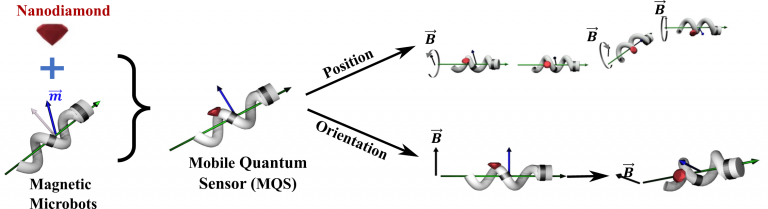
Integration of nanodiamond with microbot to from mobile quantum sensor (Credit: Eklavy Vashist)
SHARE

Researchers at the Indian Institute of Science (IISc) have developed a technique to precisely manoeuvre quantum sensors through highly viscous biological environments, such as the interior of living cells, using magnetic microbots. This opens up possibilities for real-time, minimally invasive measurement of parameters like local viscosity and temperature inside cells.


Cells are squishy and soft. Tiny nanometer-sized particles such as quantum sensors cannot move freely inside them due to viscous drag, which makes sensing challenging. “In soft environments, measurements are limited by the probability of the analyte coming close to the sensor. So, the question arises if one can instead bring the sensor [closer] and look around for the analyte,” explains Ambarish Ghosh, Professor at Center for Nanoscience and Engineering (CeNSE), IISc, and corresponding author of the study published in Advanced Functional Materials.


Ghosh’s team combined a nanodiamond quantum sensor containing a nitrogen vacancy (NV) defect with a magnetically controlled microbot. An NV defect is a specific site in the diamond lattice where a carbon atom is replaced by nitrogen, adjacent to an empty site. It has electrons whose quantum spin states depend on the surrounding environment – different physical properties such as temperature and magnetic field disturb the spin states in distinct, measurable ways. When a laser beam excites the nanodiamond, the resulting fluorescence can be used to measure multiple parameters inside the cell. The challenge was getting such a sensor to the right place. Earlier approaches used focused laser beams called optical tweezers to position and steer nanodiamonds, but the intense light could scorch cells.


The IISc team’s solution was to attach the nanodiamond to a magnetically controlled microbot and drive it through the fluid like a corkscrew. The microbot contains iron, so when an external rotating magnetic field is applied, the microbot spins to align with it. Due to its helical shape, rotation is converted into forward linear motion. This allowed the team to steer the sensor precisely in three dimensions without any light-based manipulation. Light is only needed while taking measurements using fluorescence and not to move the sensor, which minimises phototoxicity and heating.

- Advertisement -
MedBanner_Skyscraper_160x600_03/2018


At the nanoscale, there is another issue to resolve: the random thermal jostling of the surrounding molecules, called brownian motion, can cause the sensor to orient unpredictably, which could increase noise and reduce sensitivity. But because the microbot can be oriented precisely using the external magnetic field, the researchers were able to hold the nanodiamond steady, suppressing noise and recovering a clean signal.


“We are able to counter brownian motion with magnetic manipulation. This makes this platform more promising than optics or any other techniques,” says Ghosh.


To design their sensor, the team had to precisely combine a nanodiamond with a magnetic motor without having one’s properties interfering with the other. “It was not intuitive because the sensor itself may be affected by the magnetic elements,” says Eklavy Vashist, Research Associate at CeNSE and first author of the study. The team resolved this by positioning the nanodiamond approximately one micron away from the microbot’s iron head, where the motor’s magnetic field has negligible effect on the sensor.


“This sensor can also be used to look around inside living cells and measure, for instance, Reactive Oxygen Species (ROS), which is crucial in cancer and ageing,” says Ghosh.


Source: Indian Institute of Science
Published on April 09, 2026

TAGGED: nanodiamond
Admin April 8, 2026 April 8, 2026
Share This Article
Facebook Twitter Copy Link Print

Fast Four Quiz: Precision Medicine in Cancer

How much do you know about precision medicine in cancer? Test your knowledge with this quick quiz.
Get Started
Even in Winter, Life Persists in Arctic Seas

(USCGC Healy breaking through the Bering Sea waves. Credit: Chantelle Rose/NSF)   Despite…

A Biodiversity Discovery That Was Waiting in the Wings–Wasp Wings, That Is

Wing size differences between two Nasonia wasp species are the result of…

Entertainement

Coming soon

Your one-stop resource for medical news and education.

Your one-stop resource for medical news and education.
Sign Up for Free

You Might Also Like

Technology

New ‘negative light’ technology hides data transfers in plain sight

By Admin

AI set to make medical scan reports twice as easy to understand for patients

By Admin

Redefining GaN power devices for adoption in EVs and data centres

By Admin

Team develops smart synthetic material inspired by octopus skin

By Admin
Facebook Twitter Youtube Instagram
Company
  • Privacy Policy
  • Editorial Policy
  • Accessibility Statement
  • Contact US
  • Feedback
  • Advertisement
More Info
  • Newsletter
  • Beauty Lab
  • News & Perspective
  • Food & Diet
  • Health
  • Environment
  • Anatomy

Sign Up For Free

Subscribe to our newsletter and don't miss out on our programs, webinars and trainings.

Copyright © 2023 ScienceAbode. All Rights Reserved. Designed and Developed by Spirelab Solutions (Pvt) Ltd

Welcome Back!

Sign in to your account

Lost your password?