

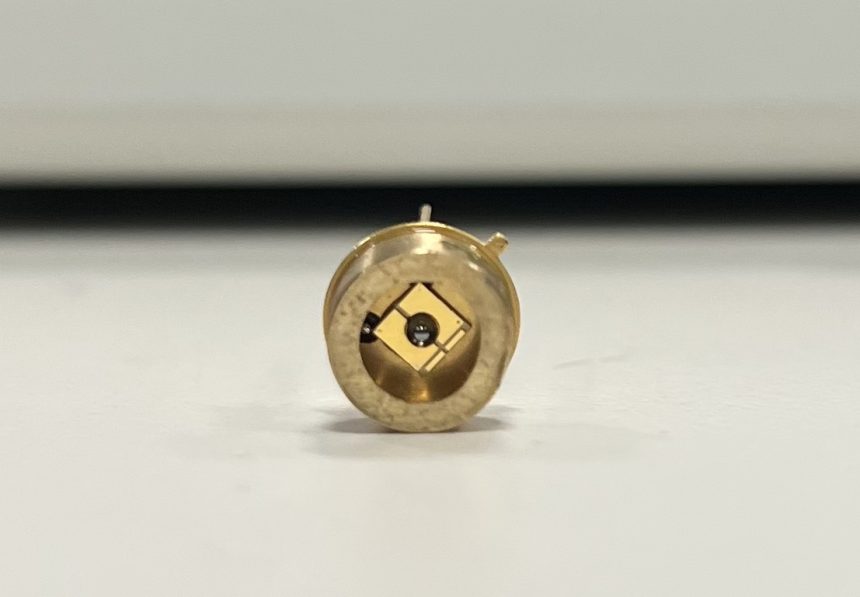
Engineers at UNSW Sydney and Monash have developed an innovative way of sending hidden information that’s hard to intercept.
Using a phenomenon known as ‘negative luminescence’, the system works by making signals blend perfectly into the background of natural heat radiation, such as can be seen with a thermal camera.
To outside observers, it looks like no data is being sent at all. Only a receiver with the right equipment can pick up the hidden message.
Because the very act of communication is invisible, the method makes signals almost impossible to intercept or hack. That means it could one day offer a powerful new security tool for sensitive communications in fields like defence and finance.
- Advertisement -

The research team, led by UNSW Professor Ned Ekins-Daukes, opens in a new window and Dr Michael Nielsen, opens in a new window, and including Professors Michael Fuhrer and Stefan Maier from Monash University and Imperial College London, have so far managed to send data at about 100 kilobytes per second in lab experiments.
But they believe speeds could reach gigabytes or even faster with further improvements to the emitter technology.
“Data is so ubiquitous nowadays, but we’re not necessarily coming up with new ways to protect that data,” said Dr Michael Nielsen, lead author from UNSW’s School of Photovoltaic and Renewable Energy Engineering, opens in a new window.
“We do have encryption methods, but at the same time we’re always having to create new encryption methodologies when bad actors find new decryption strategies.
“But if someone doesn’t even know the data is being transferred, then it’s really very hard for them to hack into it. If you can send information secretly then it definitely helps to prevent it being acquired by people you don’t want to access it.”
The new process, described in a paper published in Nature Publishing Group’s Light Science and Applications, opens in a new window, utilises the special effect of negative luminescence from LEDs operating in the mid-infrared part of the light spectrum.
Everything gives off a faint glow of heat in the infrared, which we normally can’t see – unless using special thermal cameras.
Negative light
“What makes negative luminescence so interesting is that it makes that glow look darker instead of brighter. By way of a comparison, it would be like a flashlight that can somehow go darker than ‘off’,” added Dr Nielsen.
“While that’s not possible to achieve with visible light, certain materials can create this ‘negative light’ effect in infrared, which is what the research team are now exploiting.
“In traditional data communication, information is transferred by something being either on or off. That can be as basic as a flashing light, or radio waves, or signals sent down optical fibres.
“Observers are able to see that data is being transmitted, even if they cannot read the message because of it being encrypted in some way.
“But with negative luminescence it is possible to create a hidden signal using a special device called a thermoradiative diode.”
The diode can switch output quickly between brighter and darker-than-usual states which creates a pattern that blends into the usual background ‘noise’ and is therefore invisible to anyone not aware that data is being sent.
The hidden information transmitted by such thermoradiative diodes can also be encrypted in traditional ways, adding yet another level of security.
Thermoradiative diodes
The use of thermoradiative diodes in such a way was inspired by Prof. Ekins-Daukes and his UNSW colleagues’ previous innovative work in producing so-called ‘night-time solar, opens in a new window’ – electricity created from solar power even when the sun has set.
“We technically call this new process thermoradiative signatureless communication. As part of our work on the night-time solar project we determined that the negative luminescent property was critical to how good our thermoradiative diodes performed,” said Prof. Ekins-Daukes.
“Today we have demonstrated a thermoraditive surface that can be modulated such that the signal is transmitted in all directions. Future iterations of the technology can make it directional and in the longer-term, guided in a way similar to fibre communications.”
The team are confident the data transfer speeds will increase dramatically over the proof-of-concept device reported.
“A commercial product delivering megabit data rates can be envisioned within a few years of development. Here in Sydney we have the semiconductor equipment we need to produce the next-generation prototypes of this device at the Australian National Fabrication Facility on the UNSW campus,” said Prof. Ekins-Daukes.
“For this research we have been working with mercury cadmium telluride, but we are actively exploring less toxic antimonide-based semiconductors.
“Our colleagues at Monash University have already proposed that if we could use graphene – which is a very conductive material made up of a single layer of carbon atoms arranged like a honeycomb – then we can potentially achieve data transfer rates in the gigabytes per second range, if not hundreds of gigabytes.”
Source: University of New South Wales
Published on March 16, 2026